Not All “Offline” Payment Systems Are Built the Same.
Some laundromat payment systems still rely on a live internet connection to work. Bubblepay takes a different approach — it’s built to keep your store running even during internet or cellular outages, so customers can continue using machines without interruption.
Calling offline-capable payment systems a marketing myth usually means you’ve never built one.
Bubblepay did.
In laundromat payments, the word "offline" is often treated as though it has one simple meaning. It does not.For some systems, “offline” means the store does not need a fixed-line internet connection because the payment device uses a cellular connection instead. For others, it means there is a backup network path available if the primary connection fails. In both cases, the payment experience may still depend on live connectivity at the moment the customer pays.
That distinction matters. Because the real test of an offline-capable system is not how it connects — it is whether your laundromat keeps running when connectivity disappears.
The industry is asking the wrong question.
A lot of discussion around cashless laundromat payments focuses on connectivity. Does the system use store internet? Does it use Wi-Fi? Does it use a SIM? Does it have cellular backup? Those are useful questions, but they are not the most important ones.
The better question is: What happens when connectivity is unavailable, unstable, or interrupted?
That is the point at which different laundromat payment systems begin to separate. Some are designed around constant real-time access to payment networks. Others are designed around continuity, allowing the laundromat environment to keep functioning locally and reconcile later.
Offline-capable is not binary.
The term “offline payments” is often used too loosely. In practice, there are levels of offline capability. At the most basic level, a system may not require the laundromat owner to supply fixed store internet, but it still requires a live cellular connection. That may reduce one dependency, but it does not remove connectivity dependency. If the carrier network drops, the payment path can still stop.
System Type | What Happens During Connectivity Loss |
|---|---|
Internet-dependent systems | Payment activity may stop when the store connection fails |
Cellular-only systems | Payment activity may stop if carrier connectivity is unavailable |
Failover-based systems | Payment activity continues only if a backup connection is available |
Bubblepay ecosystem | Local operation continues, with synchronization and reconciliation later |
Another model uses failover. A primary connection may be backed up by cellular, or one cellular service may be backed up by another. This can improve uptime, but the underlying assumption remains the same: the system is still trying to maintain continuous live connectivity.
Then there are outage-capable systems designed around local transaction continuity. These systems are not simply searching for another way to stay online. They are designed to keep the store operating when connectivity is temporarily unavailable, then synchronize once communication returns.
Connectivity dependency is the real issue.
A laundromat can have a good internet plan and still experience problems. Connections drop. Carriers have outages. Signal quality fluctuates. Equipment fails. Local network conditions change. Scheduled works, power events, router issues, and temporary service disruptions can all affect real-world operation.
For many businesses, a short outage is inconvenient. For an unattended laundromat, it can immediately affect revenue, customer experience, and store reputation. This is why the strongest laundromat payment architecture is not simply the one with the most connection options. It is the one that reduces the impact of connectivity loss on day-to-day operation.
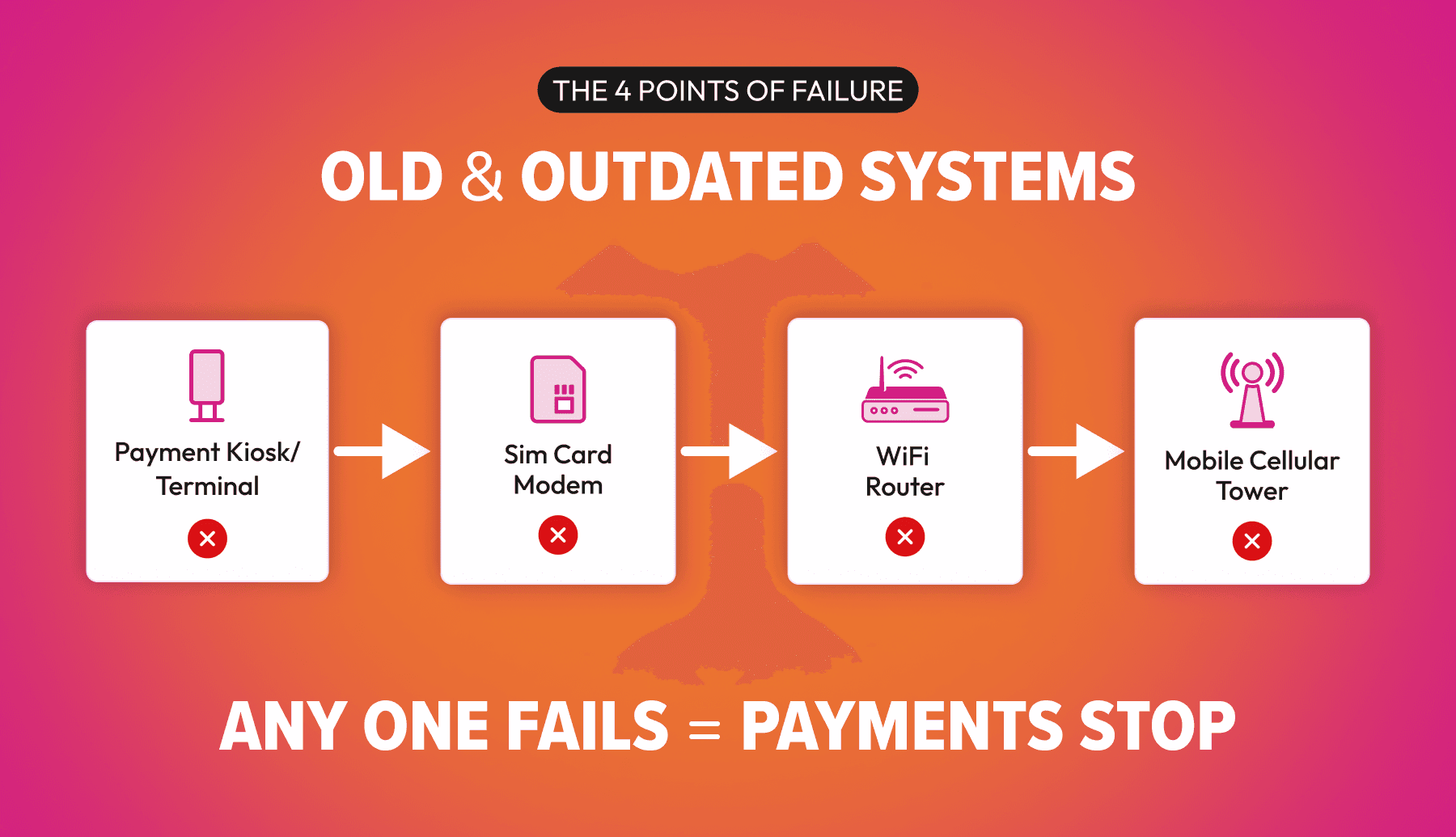
A simplified view of how chain-dependent systems can create multiple operational failure points.
Why backup internet is not the same as offline capability
It is also important to understand that internet failover is not always as simple as it sounds. In many real-world situations, the fixed internet connection does not completely disconnect. Instead, it becomes unstable, slow, or partially functional. Some traffic still passes through, which can make the router or modem believe the connection is “alive,” even while the customer experience is already breaking down.
That matters because many failover systems are triggered only when the primary connection fails in a very clear and detectable way. If the line is technically still up — but congested, timing out, or dropping packets — the switchover to 4G or another backup path may not happen immediately. In some cases, it may not happen reliably at all until the degradation becomes severe enough for the hardware to recognize it as a failure.
There is also a timing issue. Even when backup connectivity does activate, there can still be a detection delay, a switchover period, and a recovery period while sessions re-establish. During that window, customers may experience failed starts, stalled transactions, or confusing “try again” moments at the kiosk. From an operational perspective, a delayed failover is still a disruption.
This is why backup internet alone should not be confused with true offline-capable operation. Failover is a useful resilience layer, but it is still an online-first design. It assumes the system’s main objective is to restore live connectivity as quickly as possible. That is different from a system designed to keep trading locally even before connectivity has fully recovered.
A continuity-first architecture approaches the problem differently. Instead of depending on the network path to remain healthy at the exact moment of payment, it is designed so the laundromat can continue operating through interruptions, then securely synchronize and reconcile records once connectivity returns. In practice, that means less dependence on perfect network behavior and more protection for real-world store operations.
Bubblepay was built around continuity
Bubblepay’s approach is based on a simple operational principle: a laundromat should not be forced to stop just because connectivity is temporarily unavailable.
The Bubblepay ecosystem is designed to continue operating locally during internet outages and network interruptions. Transactions can continue within the store environment, with synchronization and reconciliation occurring later once connectivity returns.
That does not mean connectivity is irrelevant. It does not mean banks disappear from the process. It does not mean every transaction is guaranteed to settle successfully. It means the laundromat operation is not made entirely dependent on continuous live authorization at the exact moment a customer wants to use a machine.
In a small percentage of cases, approximately 2–3% of transactions may later reject after synchronization. That is a real consideration, and it should be stated plainly. Offline-capable architecture is not magic. It is a managed trade-off between operational continuity and delayed reconciliation risk.
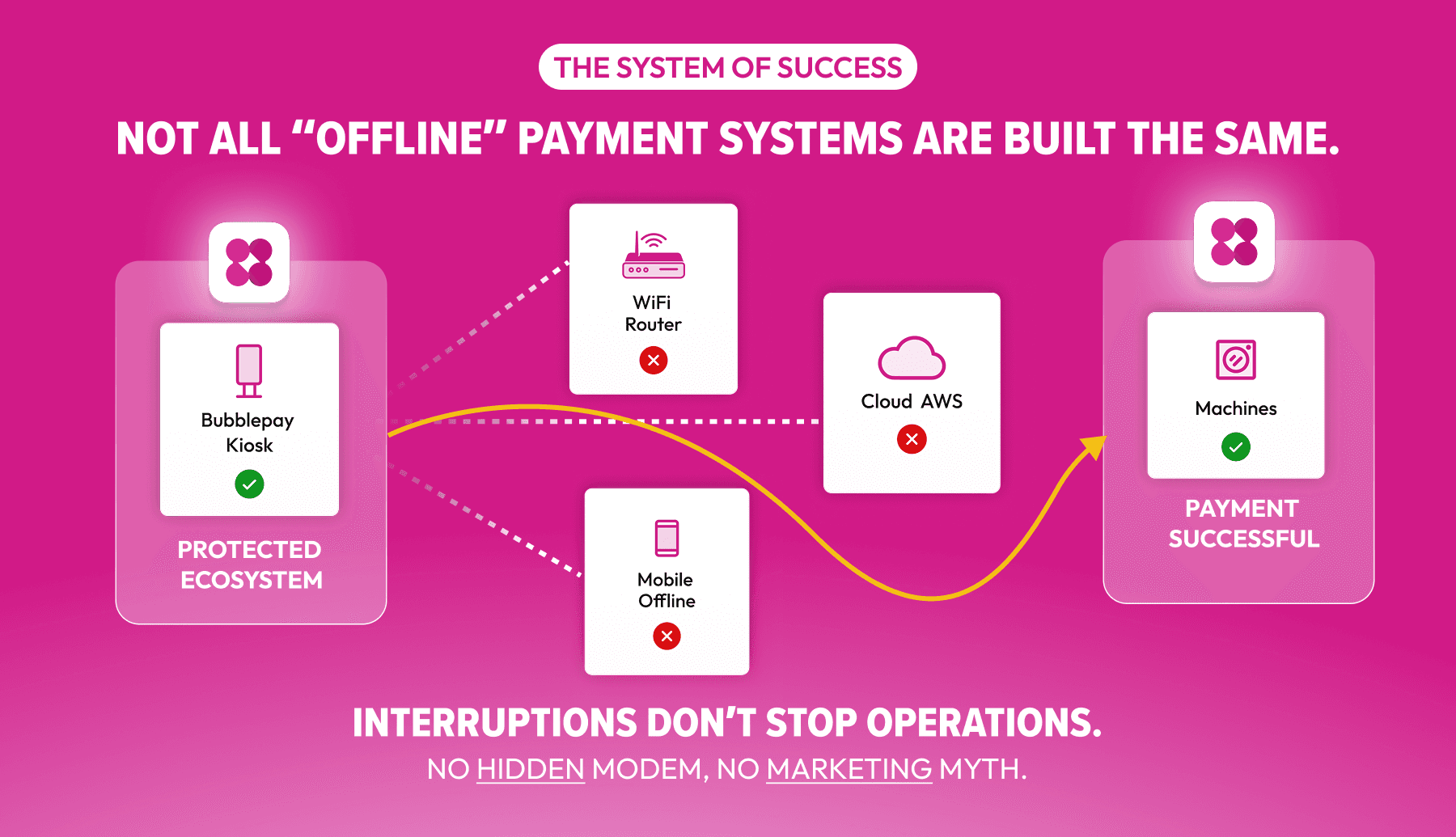
A simplified continuity model: local operation protects the customer experience while systems synchronize later.
Authorization and operation are not the same thing
Authorization is the process of validating and approving a payment through the relevant payment infrastructure. Operation is the ability of the laundromat to keep functioning: customers selecting machines, starting cycles, and completing their wash or dry.
In a perfectly connected world, authorization and operation happen together in real time. But laundromats do not operate in a perfectly connected world every hour of every year. When connectivity is interrupted, a system has a choice. It can make operation dependent on immediate authorization, or it can allow local operation to continue and synchronize later.
Why this matters for laundromat owners
A laundromat is a high-throughput, low-attention business. Owners are not trying to create a complex payment environment. They want customers to walk in, pay easily, start machines, and leave satisfied. They want fewer emergency calls, fewer failed payment moments, and fewer avoidable interruptions.
When comparing providers, owners should look beyond surface-level phrases and ask more specific questions:
Key evaluation questions
What happens if the store internet drops?
What happens if cellular connectivity also becomes unavailable?
Does the system require live authorization before every machine start?
How does synchronization work after service returns?
What is the operational trade-off between continuity and later reconciliation?
Resilience is an architectural decision
Reliable laundromat payment architecture is not only about adding more ways to connect. It is about deciding what the system should do when connection quality is no longer ideal.
A continuity-first system accepts that real-world networks can fail and designs around that reality. It reduces reliance on a single live path. It allows local operation to continue. It synchronizes later. It gives laundromat owners a more resilient foundation for daily trading.
For owners evaluating cashless laundromat payments, the deeper question is not simply, “How does the system connect?” It is, “What does the system allow my store to keep doing when connection is no longer available?”
The answer defines the architecture. And in a laundromat, architecture defines continuity.
If your payment system needs the internet to approve every start, then your laundromat is only as reliable as the weakest modem, router, carrier, or cable in the chain. Bubblepay was built differently. We do not just try to stay online. We keep the store operating when online is no longer available. When the internet fails, theory does not start machines. Architecture does.